
Wandering through Canterbury Cathedral and St. Augustine’s Abbey honestly felt like stepping straight into the roots of England’s Christian story.
Both sites overflow with history and striking architecture, marking the very dawn of Christianity in southern England.
I got to see firsthand where early leaders shaped traditions that still ripple through Britain today.
The detailed stonework of Canterbury Cathedral and the ancient ruins of St. Augustine’s Abbey make it obvious why these places matter so much.
With every step, I could almost feel the past brushing up against the present.

The beauty and deep heritage here invite you to experience both awe and understanding—there’s really nothing quite like it.
This wasn’t just another sightseeing trip for me.
It was a walk through some of England’s most meaningful chapters, and I left with a stronger sense of the history that quietly surrounds us, just waiting to be found.
The Historical Roots of England’s Christian Dawn
Strolling through Canterbury and St. Augustine’s Abbey, I couldn’t help but notice how faith, politics, and a few bold personalities all collided here.
These aren’t just old stones—they’re the starting line for Christianity’s growth in England, going back to those wild early days of the Anglo-Saxon kingdoms.
Augustine’s Mission and the Birth of English Christianity
In 597 AD, St. Augustine landed in southern England.
Pope Gregory the Great sent him to bring Roman Christianity to the Anglo-Saxons.
Augustine didn’t make the journey alone—about forty monks traveled with him, crossing Europe from Rome.
When Augustine reached Canterbury, he found mostly pagan inhabitants.
His mission wasn’t only about personal faith; it laid the groundwork for churches, monasteries, and even written records.
Augustine established the original abbey, started building churches, and became the first Archbishop of Canterbury.
His work didn’t just change English religion—it reshaped the culture, too.

Suddenly, written words became more common, law codes appeared, and monasteries became centers for learning.
Bede, the English historian, later described how Augustine’s influence helped Christianity spread across the country.
King Æthelbert and Queen Bertha: Power, Faith, and Partnership
Augustine found a powerful ally in King Æthelbert and his wife, Queen Bertha.
King Æthelbert ruled Kent, then the most influential of the Anglo-Saxon kingdoms.
Queen Bertha, already a Christian before she married Æthelbert, brought her faith with her.
She worshipped at a small church, St. Martin’s, and her presence made Augustine’s arrival possible.
With Bertha’s encouragement, Æthelbert allowed Augustine to preach openly.
The king’s conversion flipped the script.
He became the first English king to adopt Christianity, helping it take root.
Æthelbert even issued England’s earliest known written laws, influenced by both Christianity and local customs.
The Role of Canterbury in Early Anglo-Saxon Kingdoms
Canterbury quickly became the religious heart of Christianity in England.
Augustine chose Canterbury for practical reasons—it was the royal seat and close to mainland Europe, making it easy to keep in touch with Rome.
The cathedral became the archbishop’s headquarters.
Augustine’s abbey served as a base for teaching and missionary work.
From here, Christianity spread to other Anglo-Saxon kingdoms, carried by missionaries and letters from Rome.
Canterbury’s influence reached beyond faith.

It hosted major events in British history, like royal conversions and the writing of some of England’s oldest records.
Over time, it came to symbolize both spiritual leadership and continuity, even as England’s rulers changed.
Canterbury Cathedral: Gothic Masterpiece and Spiritual Heart
Canterbury Cathedral is simply breathtaking—a blend of historic architecture, spiritual depth, and artistry.
I wandered its stones, windows, and tombs, and each corner seemed to tie the past and present together.
Architecture: From Anglo-Saxon to Gothic Splendor
I entered through the cathedral’s grand entrance, knowing this place has felt sacred since 597 AD.
St. Augustine founded it, and the earliest structures were simple Anglo-Saxon buildings.
Most of those are long gone, but you can spot traces in the foundations and lower walls.
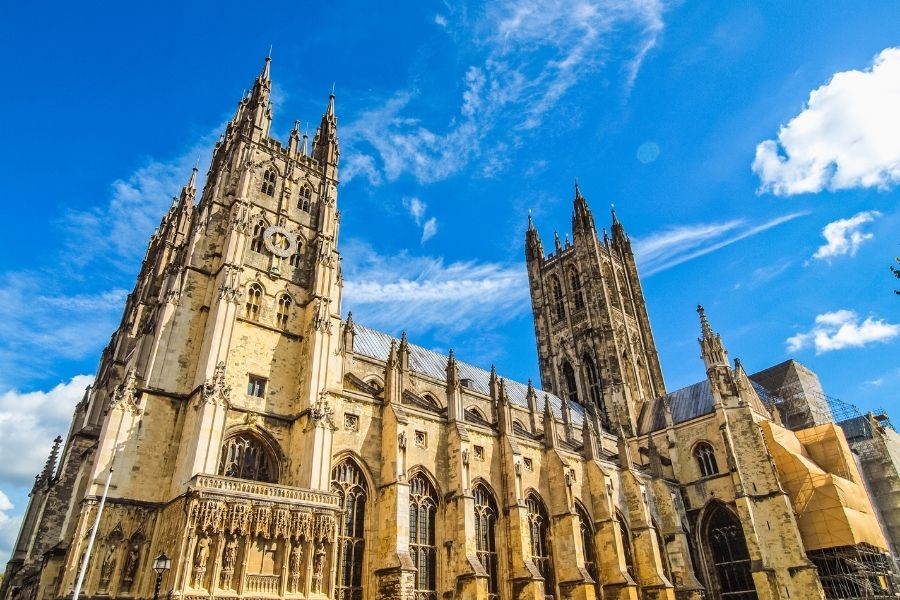
Today’s cathedral mostly grew out of the Romanesque period from the 11th century onward.
Massive stone columns and rounded arches show off that Norman design.
A huge fire in 1174 changed everything—afterward, they rebuilt in the Gothic style.
Architects brought in pointed arches, ribbed vaults, and flying buttresses.
Suddenly, the ceilings soared and the windows grew, letting in so much more light.
Key parts like the nave and Bell Harry Tower really show off these Gothic touches.
There’s something about those high vaults and sunlit aisles—they’re meant to lift your spirits, and honestly, they do.
Stained Glass Windows and Victorian Restorations
The stained glass windows caught my eye right away.
Some of them are the oldest in England, dating back to the 12th and 13th centuries.
These medieval windows show off scenes from the Bible, the lives of saints, and even pilgrims who once trekked to Canterbury.
The colors—still so bright—cast blue, red, and gold light across the stone floors.
You’ll spot medieval crowns, robes, and towers, all telling the story of faith in pictures.
During the Victorian era, people restored or replaced many windows and stone carvings.
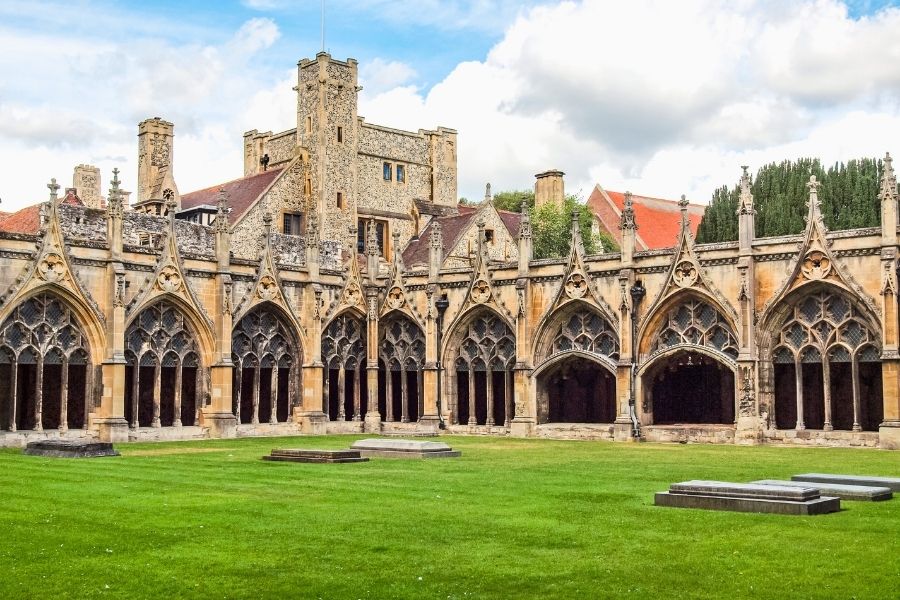
Some original glass disappeared, but Victorian craftsmen recreated the designs, mixing old and new.
Their efforts kept the cathedral’s artistic value alive.
Archbishop Thomas Becket: Martyrdom and Pilgrimage
One spot in the cathedral stands out: the site connected to Archbishop Thomas Becket.
In 1170, four knights killed Becket in the north transept.
His murder shocked medieval England and the wider Christian world.
People quickly saw Becket as a martyr.
Canterbury turned into one of Europe’s top pilgrimage destinations.
Pilgrims traveled from all over to pray at his shrine, hoping for miracles or forgiveness.
Becket’s shrine, once draped in gold and jewels, drew kings and commoners alike.
The event shaped English Christianity and even inspired Geoffrey Chaucer’s “Canterbury Tales.”
Today, a simple candle marks the martyrdom site, but the space still feels sacred.
Burial Sites, Shrines, and the Archbishops of Canterbury
As I wandered, I found burial sites of both the famous and the forgotten.
Several Archbishops of Canterbury rest here, their tombs lining the crypt and the quire.
The cathedral also became the final resting place for rulers, clergy, and figures important to church history.
Becket’s original shrine was destroyed in the 16th century, but other shrines and memorials remain.
Stone plaques, effigies, and marble slabs remind visitors of those who shaped the church and country.

Just outside, the Campanile Gardens—once the site of a bell tower—offer a quiet spot to reflect before you leave the ancient stones behind.
Inside, the long list of tombs and memorials marks Canterbury Cathedral as both a house of worship and a keeper of English religious memory.
St. Augustine’s Abbey: Foundations of Faith and Monastic Life
Visiting St. Augustine’s Abbey brought me right up against the roots of Christianity in England.
This sacred site shaped religious life, architecture, and learning for centuries.
Origins and Benedictine Monasticism
St. Augustine’s Abbey started as the Monastery of Saints Peter and Paul in 598 AD.
King Æthelberht of Kent backed St. Augustine, who had arrived from Rome to reintroduce Christianity.
With the king’s support, the abbey grew into a center for faith and learning.
The monastery became home to Benedictine monks.
They followed the Rule of St. Benedict, devoting their lives to prayer, work, and study.
The monks copied manuscripts, taught new converts, and preserved important writings.
Several saints and church leaders were connected to the abbey, making it a key player in England’s ecclesiastical history.
St. Augustine himself was buried here.
Over time, the abbey became the resting place for kings and archbishops.
Education and religious instruction spread from this center, influencing other religious houses nearby.
The Grand Romanesque Abbey and Anglo-Saxon Heritage
After the Norman Conquest in 1066, St. Augustine’s Abbey changed dramatically.
The original Anglo-Saxon buildings gave way to grand stone structures in the Romanesque style.
Thick walls, rounded arches, and ornate carvings now set the tone.
Abbot Scolland led the construction of a new church and support buildings.
Many features from the 12th century are still visible among the ruins.

The abbey’s chapel holds traces of both Anglo-Saxon and Norman craftsmanship, linking old and new worlds.
This transformation showed the abbey’s ongoing importance as a spiritual and cultural leader.
The mix of styles makes it easy to see how England’s religious architecture evolved.
Monastic Ruins: Conservation and Archaeological Insights
Walking through the abbey ruins, I could really feel how much history still lingers here.
English Heritage now cares for the site, protecting what remains of the walls and foundations.
Conservation work lets visitors explore safely and appreciate just how big this place once was.
Archaeologists have uncovered burial sites of kings and saints, old relics, and bits of earlier buildings.
These discoveries reveal details about monastic life, daily routines, and the challenges monks faced over the centuries.
There’s a museum on site, too.
Artifacts and exhibits tell the abbey’s long story—from Roman times through the Reformation in 1538, when the monastery was dissolved.
Seeing these items up close gave me a real sense of the abbey’s lasting legacy.
St. Martin’s Church: England’s Oldest Parish Church
St. Martin’s Church in Canterbury proudly stands as the oldest parish church still in use in England.
Its origins go back even before Canterbury Cathedral and St. Augustine’s Abbey, acting as a bridge between the Roman past and Anglo-Saxon England.
Roman and Anglo-Saxon Architectural Features
Walking up to St. Martin’s, I could see right away that the building is a blend of Roman and Anglo-Saxon work.
Some walls use Roman bricks and tiles—easy to spot from outside.
These parts date from an earlier Romano-British structure, proving the church’s roots reach back at least to the late 6th century.
The stonework feels ancient, with small windows and simple shapes.

Parts of today’s church, especially the nave and certain doorways, show classic Anglo-Saxon features—thick walls and narrow arches.
While there have been later changes, the basic shape and much of the foundation come from those early Christian centuries.
Here’s a quick look at some key features:
| Feature | Period | Notes |
|---|---|---|
| Roman bricks and tiles | Roman | Used in lower walls |
| Anglo-Saxon stonework | 6th–7th c. | Simple windows, thick walls |
| East end extensions | 12th–13th c. | Later medieval alterations |
Place of Worship for Queen Bertha
When I stepped into St. Martin’s, I couldn’t help but imagine Queen Bertha—this Christian Frankish princess—worshipping here around AD 580. She came over from the continent before the church ever got famous.
Her husband, King Æthelberht of Kent, was pagan, but he let her keep her faith. She took what was basically a forgotten Roman structure and turned it into her own private chapel.
Queen Bertha’s worship here shaped the Christian history of England in a big way. Alongside Bishop Liudhard, her chaplain, Roman Christianity found its first real home in England—well before Augustine even showed up.
This little parish church kicked off the spread of Christianity across southern England. Because St. Martin’s was already active before Augustine’s mission, it stands out as a crucial early Christian site.
The church’s story ties together a queen’s faith, the clever reuse of old buildings, and how Christianity rose to become the faith of English kings. The space itself? It’s simple, but honestly, I found it moving—a direct link to the very beginnings of the Church of England.
UNESCO World Heritage and the Trio’s Outstanding Universal Value
Canterbury Cathedral, St Augustine’s Abbey, and St Martin’s Church together make up a UNESCO World Heritage Site unlike any other. They showcase nearly 1,500 years of English Christian history.
They also play a pretty important role in global heritage conservation.
Inscription and Global Significance
UNESCO added this trio to their list in 1988 for their Outstanding Universal Value. The Cathedral is the spiritual heart of the Church of England, while St Martin’s is the oldest church in the country.
St Augustine’s Abbey marks the start of Christianization by St Augustine in 597 AD. That’s a lot of history packed into one city.
But “Outstanding Universal Value” isn’t just a fancy phrase. UNESCO uses it for places that matter to everyone, not just one country. Here, you see Romanesque and Gothic styles side by side, ancient tombs, and centuries-old artifacts that show how faith and society changed over time.

These sites also keep rare medieval manuscripts and stained glass safe for future generations. Scholars from all over the world come here to study them.
Visiting Tips: Guided and Private UNESCO Tours
I honestly got so much more out of my visit by joining a guided tour. The guides pointed out details I never would’ve noticed alone. They dive deep into the architecture, archaeology, and spiritual meaning behind everything.
Some tours offer private UNESCO experiences—so you can move at your own pace and ask all your burning questions. Several companies run both group and private tours, and English Heritage at St Augustine’s Abbey has its own sessions too.
I spotted some pretty cool virtual reality features at the Abbey museum. They helped me picture what things looked like centuries ago. If you’re visiting during busy times, booking ahead is a smart move, especially for special tours.
Conservation, Exhibitions, and Educational Efforts
Dedicated teams of stonemasons, historians, and volunteers lead the conservation efforts here. I saw them hard at work in parts of the Abbey, carefully restoring ruins and cleaning the fragile stonework and stained glass.
Inside the Abbey’s museum, exhibitions display early medieval artifacts—stone crosses, relics, all sorts of treasures. They often run educational programmes for students and families, with hands-on activities, talks, and trail leaflets.
These resources make it easier to understand why the site matters, and how people have worked to protect it through the years.
Pilgrimage, Everyday Life, and Experiencing Canterbury Today
Wandering through Canterbury, I noticed how tradition, faith, and everyday life all mix together. Visitors still come to walk ancient paths, soak up cathedral music, and discover Kent’s unique corners.
Pilgrimage Routes and Modern Practices
When I got to Canterbury, signs for old pilgrimage routes caught my eye right away. The Pilgrims’ Way, running from Winchester to Canterbury, is the most famous. It follows the same path Chaucer’s pilgrims took ages ago.
Modern pilgrims can collect “pilgrim passports” and get them stamped at the cathedral—a fun way to mark the journey. The walk itself winds through woods, fields, and tiny Kent villages.
Some travelers come for spiritual reasons, while others just love the peaceful countryside or want to dig into history. Popular stops include the Reculver Towers on the coast, and hidden gems like the Conduit House and Water Tower.
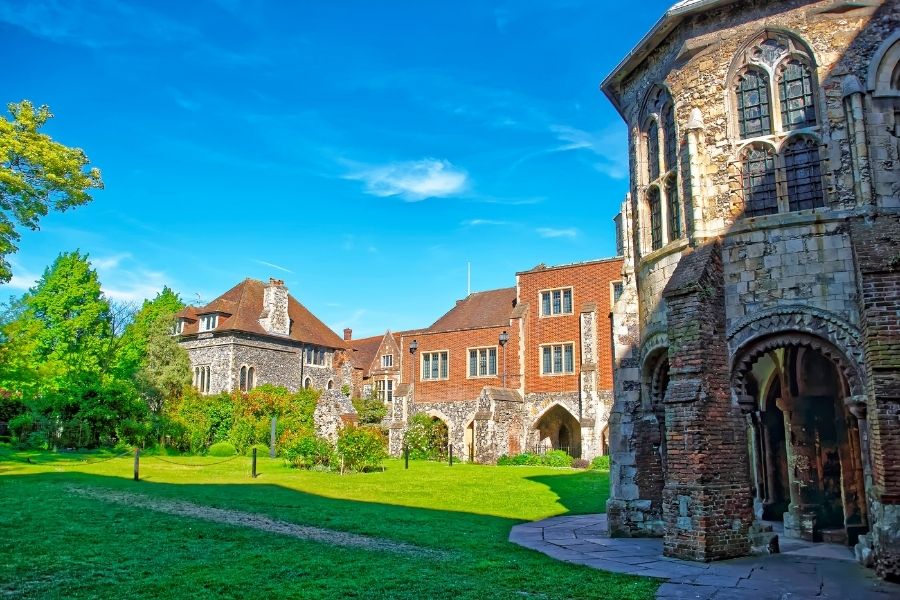
Even though the route is ancient, I met all kinds of people on it—families, walkers, and those just wanting some quiet time to reflect.
Ongoing Worship, Choral Evensong, and Community Events
Canterbury Cathedral still holds daily worship for the local community. One highlight for me was Choral Evensong. The music echoed through the vast space and brought a calm end to my day. You don’t need to be religious to enjoy it—anyone can just come in and listen.
The cathedral also puts on public lectures, art shows, and seasonal events like Christmas markets. St. Augustine’s Abbey runs tours that focus on history and archaeology. Sometimes, I joined workshops or relaxed family programs that made faith and history come alive for everyone.
When worship isn’t happening, the grounds feel peaceful but never empty. Visitors, music, and local groups fill the space with life. It’s clear this isn’t just a museum—it’s a place where people still gather, celebrate, and connect.
Practical Information for Visitors
Before heading out, I always check the official websites since the cathedral and abbey change their opening times for special services or events. Most days, Canterbury Cathedral welcomes visitors from early morning until late afternoon.
Getting around is pretty straightforward. Accessible paths and ramps let everyone explore without much hassle.
There are a couple of cafés on site, and they actually do a decent job with different dietary needs. Whether you want just a snack or a proper lunch, you’ll find something.
I spotted clear signs pointing to the museum, which made things a lot easier. Guided tours are available in several languages, so you don’t have to worry if English isn’t your first language.
You can grab tickets online or just pick them up at the entrance. Families and kids get discounted rates, which is always a bonus.
If you’re coming by train, it’s a quick walk—less than 15 minutes from the station to both the cathedral and the abbey. Honestly, it’s one of the easiest day trips you can do in Kent.
