
When I first saw the Leaning Tower of Pisa standing at that famous tilt, I couldn’t help but wonder about the science behind this architectural marvel. This iconic structure in Italy wasn’t actually meant to lean at all! The tower leans because its foundation was only 3 meters deep, built on unstable soil that began to shift during construction in the 12th century.
What started as a design flaw has become one of the world’s most famous landmarks. The tower now leans at an angle of about 4 degrees after restoration work between 1993 and 2001 stabilized the structure.
Engineers carefully strengthened the base while preserving its characteristic tilt, ensuring it would remain standing for at least another 300 years.

Beyond its architectural significance, the Leaning Tower has played an important role in physics history. It was here that Galileo allegedly conducted his famous experiment showing that objects fall at the same rate regardless of their mass – a breakthrough that changed our understanding of gravity.
Walking around this tilted wonder, I’m always struck by how science and architecture have connected in such a remarkable way.
The Historical Context of Pisa’s Tower
The Leaning Tower of Pisa began as a symbol of prosperity in medieval Italy but became famous for its engineering flaw. Started in 1173, this bell tower was part of a magnificent cathedral complex showcasing Pisa’s wealth during its golden age.
Architectural Wonders of Pisa
Pisa was a powerful maritime republic in the 12th century. The city leaders wanted to show off their success with grand buildings. They created a stunning complex in what’s now called the Square of Miracles.
This area includes the Cathedral of Pisa, the Baptistery, the Cemetery, and of course, the famous tower. The cathedral was built first in 1063, and the tower was meant to be its bell tower.
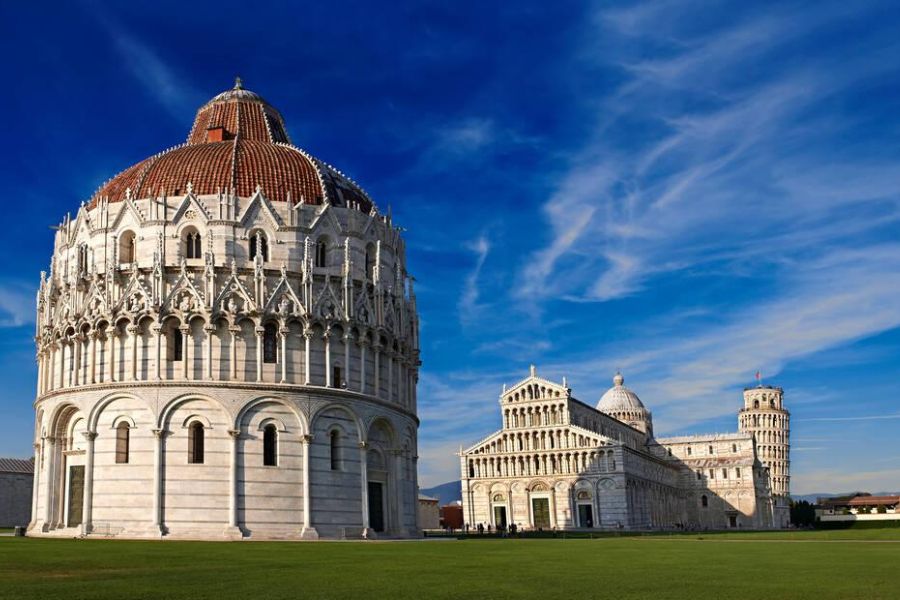
These structures use the distinctive Pisan Romanesque style. White marble was the primary building material, creating a striking appearance against the green lawns surrounding them.
Conception of the Leaning Tower
Construction of the tower began in 1173 under architect Bonanno Pisano. The project was ambitious – a freestanding bell tower rising about 60 meters high.
The builders laid a shallow foundation, only about 3 meters deep. This proved insufficient for the soft, unstable soil beneath. After reaching the third floor in 1178, work stopped for nearly a century due to wars and the obvious tilting problem.

Later architects, including Giovanni di Simone, tried to correct the lean by building upper floors with one side taller than the other. This created the tower’s curved shape. Despite these challenges, construction finally finished in the late 13th or early 14th century.
The tower’s tilt wasn’t planned – it was an accident that became its defining feature and saved it from being forgotten in history.
Understanding the Tilt
The famous lean of the Tower of Pisa stems from engineering challenges and environmental factors that began nearly 850 years ago. This architectural mishap transformed into one of the world’s most recognizable landmarks despite never being planned.
The Science of Structure and Leaning
The Tower of Pisa’s tilt started during construction in 1173. Builders noticed the lean after completing just three stories! The tower sits on soft ground with clay, sand, and water beneath it. This unstable foundation caused one side to sink more than the other.
What’s fascinating is how builders tried to fix the problem. When architect Giovanni di Simone took over in 1272, he made an interesting choice. He built the upper floors with one side taller than the other, trying to curve the tower back toward straightness. This created the tower’s banana-like shape that we see today.

The tower leans at nearly four degrees. Without modern interventions, it would have eventually collapsed. The structure itself is remarkably strong despite its tilt, distributing weight through its cylindrical design.
Soil Composition and Construction Challenges
The main culprit behind the famous lean is the soil beneath the tower. Pisa sits on what engineers call a “particularly soft” mixture of clay, fine sand, and shells. This soft ground couldn’t support the tower’s weight evenly.
The foundation was also problematic. At just 3 meters deep, it wasn’t adequate for such a tall structure. When builders noticed the tilt, they paused construction for nearly 100 years! This actually helped by giving the soil time to settle.
Weather plays a role too. Seasonal changes in the water table beneath the tower cause it to shift slightly throughout the year. Before modern stabilization efforts, the tower leaned about 1-2 millimeters per year.
Engineers in the 1990s finally stabilized the tower by removing soil from the high side, allowing it to settle back slightly. This reduced the tilt without eliminating the tower’s famous lean that attracts millions of visitors annually.
Preservation Efforts and Engineering Solutions
The Leaning Tower of Pisa has survived for centuries despite its famous tilt. Engineers and preservation experts have worked tirelessly to prevent its collapse while maintaining its iconic lean.
Combatting the Risk of Collapse
In the early 1990s, the tower reached a dangerous tilt of 5.44 degrees, dangerously close to the catastrophic threshold of 5.5 degrees. I was amazed to learn that this beloved landmark was on the brink of toppling over! The Italian government closed the tower to visitors in 1990 and assembled a team of experts to tackle this monumental challenge.
The first stabilization attempts involved adding 800 tons of lead counterweights to the north side. This temporary solution bought engineers time to develop more permanent fixes. I’ve seen photos of these massive weights, which looked oddly out of place against the tower’s elegant marble.

When I visited the site, a guide explained how soil extraction became the winning strategy. Between 1993 and 2001, engineers carefully removed small amounts of soil from beneath the north side, allowing the tower to gently shift back toward center.
Innovative Techniques for Stability
The soil extraction method was truly ingenious. Engineers inserted drill bits under the high side of the tower and removed about 70 tons of soil gradually. I find it fascinating that this seemingly simple approach reduced the lean by 19 inches without damaging the structure!
Another brilliant technique involved using steel cables as temporary braces while work was being done. These weren’t permanent solutions but helped prevent sudden movements during the delicate soil extraction process.
The tower’s foundation was also reinforced using a technique called “underexcavation.” This approach has since become a model for preserving other historic leaning structures worldwide. When I examined the tower closely, I couldn’t detect any visible signs of these interventions—a testament to the careful preservation of its aesthetic qualities.

The restoration has been so successful that experts now believe the tower should remain stable for at least another 200 years. What a relief for future generations of travelers like me!
Pisa Today: Tourism and Cultural Significance
The Leaning Tower of Pisa has transformed from an architectural mishap into one of the world’s most recognized landmarks. Today, this tilting wonder draws millions of visitors annually and has become deeply woven into both local Italian culture and global heritage.
The Leaning Tower as a Travel Destination
I’ve noticed that few monuments capture visitors’ imagination quite like the Leaning Tower of Pisa. The tower welcomes over one million tourists each year, all eager to take the iconic “holding up the tower” photo.
Tickets to climb the 294 steps to the top often sell out weeks in advance, especially during summer months. The experience of feeling the 4-degree tilt while ascending the spiral staircase is truly unique.
The tower sits within the larger Piazza dei Miracoli (Square of Miracles), where you’ll also find the Cathedral, Baptistery, and Camposanto. Many visitors don’t realize this UNESCO World Heritage site offers much more than just the famous leaning structure.

Local businesses have flourished around tower tourism, from gelato shops to souvenir stands selling miniature replicas in every size imaginable.
Cultural Identity and Global Recognition
The tower has become Italy’s unmistakable symbol, appearing in countless films, advertisements, and media worldwide. What fascinates me is how this architectural accident has transformed into a celebrated cultural icon rather than an engineering embarrassment.
For Pisans, the tower represents both civic pride and economic opportunity. Local festivals and celebrations often incorporate tower imagery, and many residents work in tourism-related industries.
The tower’s continuing tilt creates ongoing global interest. Engineers’ successful efforts to stabilize it at a safe 4-degree angle in the early 2000s made international headlines. This preservation project ensures future generations can experience this remarkable structure.
The Leaning Tower has inspired countless imitations worldwide, from Las Vegas to China, but nothing compares to seeing the original’s distinctive tilt against the Tuscan sky.
Architectural Legacy and Educational Insights
The Leaning Tower of Pisa stands as both a marvel of medieval engineering and a powerful lesson in architectural planning. Its distinctive tilt has influenced modern building practices and provided valuable insights for engineers and architects worldwide.
Influences on Contemporary Architecture
The Tower’s unexpected lean has actually inspired some intentionally tilted designs in modern architecture. Several contemporary buildings deliberately incorporate angles as aesthetic features, paying homage to Pisa’s famous landmark.
What fascinates me is how the Tower’s ability to stand despite its tilt has informed structural stability techniques. Modern architects study it to understand how buildings can withstand stress and imbalance.

The Tower also demonstrates the importance of material selection. Its marble façade has weathered centuries remarkably well, inspiring today’s designers to consider long-term durability alongside immediate visual impact.
Lessons Learned from the Leaning Tower
The Tower teaches us the crucial importance of proper foundation work. The architects’ decision to build on unstable soil with only a three-meter foundation proved insufficient for an eight-story structure.
Site analysis has become standard practice in modern construction because of failures like this. Engineers now conduct thorough soil tests before breaking ground on major projects.
The Tower also teaches us about the value of patience in construction. The 200-year building process, with its multiple pauses, actually helped the structure stabilize between phases.
What began as an architectural mistake has become an enduring educational tool. Engineering and architecture schools worldwide use the Tower as a case study in structural principles, soil mechanics, and preservation techniques.